Virtual Reality
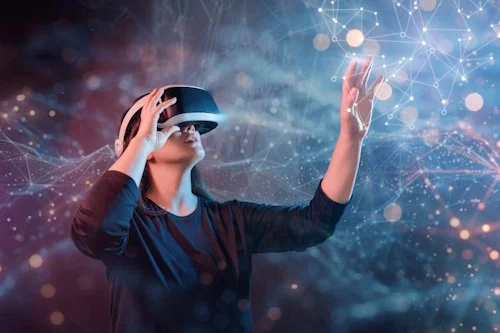
Virtual Reality (VR) is transformative for science communication, offering an immersive, interactive medium that makes abstract or microscopic concepts tangible and engaging for the public. By enabling "first-person" experiences, such as traversing the human bloodstream or exploring distant planets, VR fosters emotional connection and empathy, which is crucial for communicating complex environmental or medical issues.
Key benefits of VR in science communication include:
Enhanced Visualization: It transforms complex, invisible, or microscopic phenomena (e.g., molecular bonds, virus propagation) into clear, 3D, and interactive visuals, increasing comprehension.
Increased Engagement & Retention: Unlike passive media, VR drives active learning. Research shows that immersive experiences can increase knowledge retention by up to 75% compared to traditional methods.
Accessibility to the Inaccessible: VR allows users to "visit" dangerous, distant, or impossible locations, such as the bottom of the ocean or the center of a volcano, bridging the gap between scientific research and public understanding.
Actionable Insights: It allows users to manipulate data and variables, such as adjusting environmental factors in climate models, to immediately witness consequences, encouraging deeper, inquiry-driven understanding.
As VR hardware becomes more accessible, its role in museums, classrooms, and online platforms is shifting science communication from passive consumption to immersive, memorable exploration.
Insight is currently developing new methods for exploring brain anatomy using Virtual Reality. Our expertise is in mathematical modelling and computer programming using Unity and Unreal Engine. We would like to work with you on your needs for Virtual Reality.
Insight is based within the Gold Coast Health and Knowledge Precinct. Our staff are members of Australian Science Communicators and the Australian Academy of Cinema Television Arts (AACTA). Insight is a member of Experience Gold Coast.